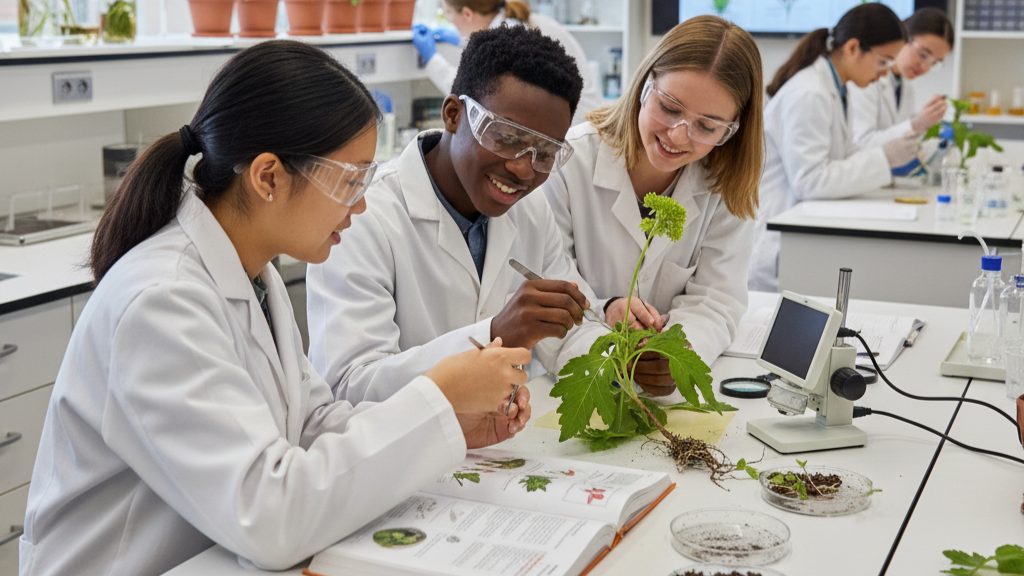
Are you looking for a robust, lab-centric biology experience that brings life science to life? This course is designed specifically for homeschooling families who want their students to do science, not just read about it. We transform the abstract world of living things into tangible, hands-on experiences, ensuring your student builds the analytical skills necessary for career and college-level thinking.
Through a series of rigorous experiments, dissections, and data-driven investigations, students will explore the following core pillars of biology:
What Your Student Will Explore:
- Scientific Observation and Microscopy: Students will learn the “tools of the trade” by mastering the compound microscope, preparing wet-mount slides, and accurately documenting microscopic observations of cells and microorganisms.
- Cell Structure and Function: We dive deep into the fundamental unit of life, exploring cellular organelles, membrane transport, and the vital processes of photosynthesis (demonstration) and respiration.
- Mastering the Lab Report: In this foundational activity, students transition from “doing an experiment” to “communicating science.” Using data from our investigations, students will learn to structure their findings into a formal, college-prep document.
- Genetics and DNA: We explore the mechanisms of heredity, from Mendelian principles to modern molecular biology. Students will perform a hands-on DNA extraction and simulate genetic concepts like genotype and evolution.
- Biochemistry and Enzymes: Students will investigate the chemical reactions of life, conducting experiments to study the effectiveness of enzymes and the role of biomolecules in processes like digestion and metabolism.
- Comparative Anatomy and Dissection: We investigate the diversity of life through hands-on examination. Students will practice proper dissection techniques on specimens (arthropod and amphibian) to understand organ systems and evolutionary relationships.
Why Science Lab Matters:
In this course, we prioritize the Scientific Method. Your student won’t just follow a “cookbook” recipe; they will:
- Formulate testable hypotheses.
- Manage lab safety and precision equipment.
- Analyze data to draw evidence-based conclusions.
Note to Parents: This lab sequence is designed to meet standard high school credit requirements and provides the portfolio-ready work samples often needed for college admissions or transcripts.
The lecture+lab class is ideal for:
- Homeschool students wanting a complete biology curriculum (with or without tests and other assignments)
- Students who learn best through hands-on science
Planned Lectures + Lab scope and sequence (Subject to change):
Aug 25: Scope and Science of Biology
Sep 1: Science of Biology
Sep 8: Process and Science of Studying Animal Behavior + Lab Friday
Sep 15: Chemistry of Life
Sep 22: Chemistry of Life Part 2 – Lab Report Review + Lab Friday
Sep 29: Molecules that Comprise Life Part 1
Oct 6: Molecules that Comprise Life Part 2 + Lab Friday
Oct 13: Tour of the Cell Part 1
Oct 20: The Working Cell: Energy from Food + Lab Friday
Oct 27: The Working Cell: Energy from the Sun + Lab Friday
Nov 3: Cellular Basis of Inheritance
Nov 10: Patterns of Inheritance + Lab Friday
Nov 17: Genotype
Nov 24: No Class
Dec 1: DNA & the Language of Life
Dec 8: Human Genetics
Dec 15: Frontiers of Genetics
(winter break)
Jan 5: Evolution
Jan 12: Origins of Biological Diversity
Jan 19: Prokaryotes & Viruses + Lab Friday*
Jan 26: Protists
Feb 2: Fungi
Feb 9: Fungi + Lab Friday*
Feb 16: Introduction to Plants
Feb 23: Plant Diversity & Reproduction + Lab Friday*
Mar 2: Plants
Mar 9: Life of a Flowering Plant
Mar 16: Invertebrate Diversity + Lab Friday*
Mar 23: No Class
Mar 30: Arthropods
Apr 6: Vertebrates: Fish and Amphibians + Lab Friday*
Apr 13: Vertebrates: TBD
Apr 20: Vertebrates: Reptiles, Birds, Mammals + Lab Friday*
Apr 27: Human Organism: An Overview & Nervous System
May 4: Cardiovascular and Respiratory Systems
May 11: Nutrients and Digestion
*Spring Lab Meeting times to be confirmed with the Town Hall November 2026*
Students are expected to participate actively, respect instructors, and follow all lab safety guidelines.