All lectures will meet online.
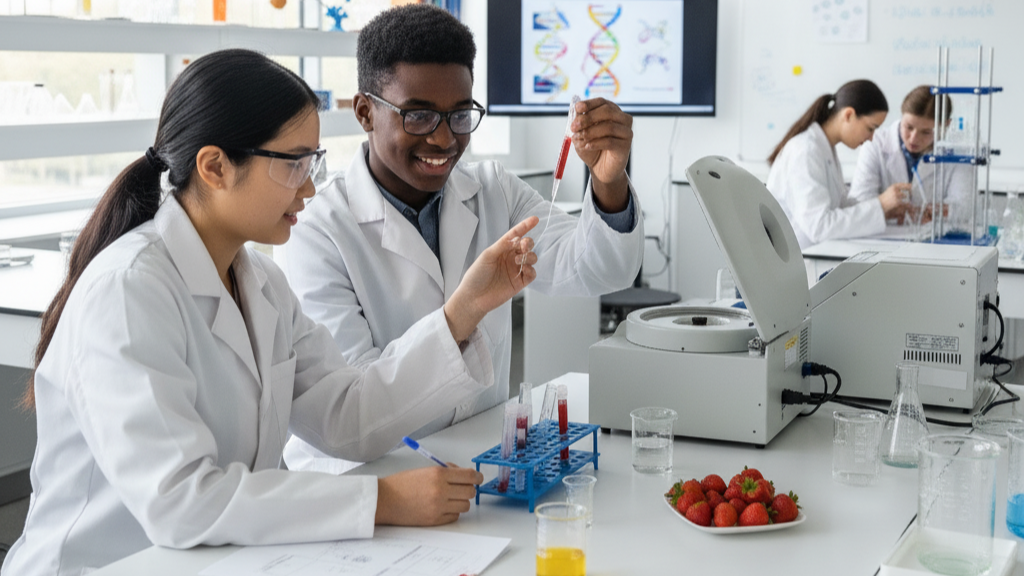
Are you looking for a robust chemistry experience that moves beyond the textbook? This course is designed specifically for homeschooling families who want their students to do science, not just read about it. We transform abstract concepts into tangible experiences, ensuring your student builds the analytical skills necessary for career and college-level thinking.
Through a series of rigorous data-driven investigations, students will explore the following core pillars of chemistry:
What Your Student Will Learn:
- Scientific Measurement: Students will learn the “tools of the trade” by exploring the difference between accuracy and precision. Using metric tools, students will measure mass, volume, and density.
- Mixtures & Solutions: We dive deep into the physics of mixing. Students will practice separation techniques for complex mixtures and explore the molecular “why” behind mixtures.
- The Development of Atomic Theory: We don’t just memorize names; we explore the history of atomic theory to understand how scientific theories adapt. Students will simulate classic experiments to see how we discovered the invisible.
- The Language of the Periodic Table: Students will decode the “map of the universe,” predicting elemental behavior based on trends, electron configurations, and group properties.
- Chemical Bonding Strength: From ionic lattices to covalent molecules, we investigate the forces that hold matter together. We’ll test bonding strength through melting points, conductivity, and solubility.
The lecture class is ideal for:
- Homeschool students wanting a complete chemistry curriculum (with or without tests and other assignments)
- Students who learn best through live interactive instruction and collaborative discussions.
Planned Lecture (subject to change):
Aug 25: What Chemistry Is & How It Affects Everything
Sep 1: Matter and Change
Sep 8: Matter and Change Part 2
Sep 15: Scientific Measurement
Sep 22: Atomic Structure
Sep 29: Atomic Structure Part 2
Oct 6: Electrons in Atoms
Oct 13: Electrons in Atoms Part 2
Oct 20: Periodic Table Part 1
Oct 27: Periodic Table Part 2
Nov 3: Ions – Types and Forms
Nov 10: Bonds: Ionic and Metallic
Nov 17: Bonds: Covalent
Nov 25: No Class
Dec 1: Bonds:
Dec 8: Monoatomic & Polyatomic Ions
Dec 15: Monoatomic & Polyatomic Ions
(winter break)
Jan 5: Chemistry Math
Jan 12: The Mole – Mole Conversions
Jan 19: Reactions
Jan 26: Mole–Mole and Mole–Mass Calculations Part 1
Feb 2: Mole–Mole and Mole–Mass Calculations Part 2
Feb 9: States of Matter – Gases & Liquids
Feb 16: States of Matter – Solids & Changes of State
Feb 23: Gas Laws Part 1
Mar 2: Gas Laws Part 2
Mar 9: Properties of Water
Mar 16: Aqueous Solutions Part 1
Mar 23: No class
Mar 30: Aqueous Solutions Part 2
Apr 6: Thermochemistry
Apr 13: Acids, Bases, and Salts Part 1
Apr 20: Acids, Bases, and Salts Part 2
Apr 27: Oxidation–Reduction Reactions
May 4: Nuclear Chemistry
May 11: Electrochemistry
Students are expected to participate actively and respect instructors.